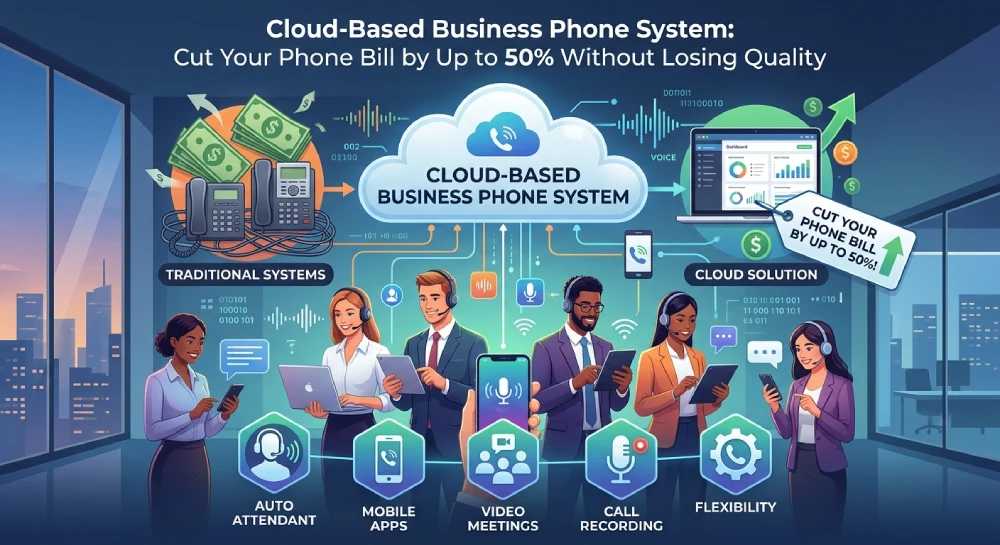
Traditional office phone systems can become expensive as a business grows. There are a number of costs that can come with hardware, maintenance, phone lines, upgrades and long-distance charges and these can add up to the monthly bill. A cloud-based business phone system shifts a lot of that infrastructure online, providing businesses with a greater flexibility in call management.
This can be a reduction in costs for small and growing businesses without loss of features that employees need. The answer is knowing how cloud phone systems function and also contrasting the overall price to standard options.
What Is a Cloud-Based Business Phone System?
A cloud-based business phone system is a system that relies on an internet network for business calls, rather than on conventional phone equipment. Desk, computer, tablet or mobile phones can be used to make and receive calls.
You can also add employees, configure extensions, and work with a remote team faster with a cloud phone system. When businesses grow, they don’t have to invest in costly equipment for the location.
When considering business phone system costs, consider setup fees, user licenses, international calling costs, hardware, support, integrations, and more.

Understanding Business Phone System Prices
The business phone system prices you see online can vary considerably depending on the provider and features included. Some services have user fees, others have various calling volume and/or functionality plans.
If you are interested in comparing the cost of office phone systems options, you should not only look at the monthly subscription, but also at the yearly cost as well. The lower cost option might be higher when you add on features and support.
What Affects Business Phone System Pricing?
Several factors influence business phone system pricing, including:
- Number of users and extensions
- Calling minutes and destinations
- Desk phone requirements
- Mobile and desktop applications
- Customer support
- Call recording
- Video conferencing
- CRM integrations
- Automated attendants
- AI-powered features
- PSTN connectivity
Knowing these factors can help make it easier to compare plans according to what you really need in your business instead of the headline prices. A cloud based phone system for small business may be specifically beneficial due to the fact that the systems can be deployed as a result of a small number of users and expanded as required.
Important Business Phone System Features
The appropriate business phone system is reliable to your team’s communication needs. For some businesses, basic calling will suffice, but for those who have customer facing teams, they will need more sophisticated tools.
Some of the useful features are:
- Auto attendants
- Call forwarding
- Call queues
- Voicemail-to-email
- Mobile applications
- Call analytics
- Call recording
- Business texting
- CRM integrations
- Video meetings
- Team messaging
If you only select the features that your team will be using, you can also keep the monthly fees reasonable. Access to the PSTN connectivity may still be required for businesses with calls made via the internet.
Call Recording and Other Advanced Tools
Call recording technology is helpful for communication training, quality control, customer service, and reviewing significant calls. Businesses should also be aware of privacy and recording consent requirements that may apply in specific circumstances or industries, based on location.
Other sophisticated tools can make cloud-based phone systems more valuable. For instance, an AI phone system can answer common inquiries, direct callers, record conversations or assist employees with repetitive communication duties.
How to Choose the Right Cloud Phone Service
When selecting a cloud phone service, don’t just take the advertised price as your sole criterion. Consider reliability, call quality, mobile support, security, integrations, customer service, and pricing for cloud-based business phone system.
Ask if they can add and remove users with ease, if there is any possibility of moving numbers, what they do if you overuse your plan, and if there are any features included in your plan.
Can a Cloud Phone System Really Cut Costs?
It can, especially in the case of a company that is swapping out its costly equipment and legacy telephony system. However, actual savings are based on the company’s existing configuration, users, calling volume and the features chosen.
Don’t assume that all businesses will save the same amount, but compare your current phone bill to the total annual cost of one or more cloud solutions. This will provide you with a better estimate of what you can expect to save.

Conclusion:
A cloud-based business phone system can provide a more flexible alternative for a small or growing business to traditional office-based phone infrastructure. Businesses can save on hardware and maintenance costs, and enjoy additional features like mobile calling, call recording, analytics, and AI support, with the right plan in place.
The cheapest plan may not be the best. When choosing a business phone system, you’ll want to compare prices, features, connectivity, implementation support, and the total long-term cost of the business phone system to make sure you get the best value for your money.
Frequently Asked Questions
What is a cloud-based business phone system?
It is a business calling system that uses the internet and cloud-hosted technology rather than relying entirely on physical phone infrastructure.
Is a cloud phone system good for small businesses?
Yes. A cloud system can be useful for small businesses because users can often be added easily without installing extensive hardware.
How much does a business phone system cost?
The cost varies based on users, features, calling requirements, hardware, and provider pricing. Businesses should compare the complete cost rather than only the monthly rate.
What affects business phone system pricing?
User count, calling volume, features, phone numbers, integrations, support, hardware, and international calling can all affect pricing.
What features should a business phone system have?
Common features include call forwarding, voicemail, auto attendants, call queues, mobile apps, analytics, business texting, and call recording.
Does a cloud phone system need internet?
Yes. Cloud-based calling generally relies on an internet connection, so businesses should have a reliable network.
What is PSTN connectivity?
PSTN connectivity allows a cloud communication platform to connect with traditional public telephone networks.
Is call recording included with cloud phone services?
It depends on the provider and plan. Some include it, while others offer it as an additional feature.
What is an AI phone system?
An AI phone system uses artificial intelligence to assist with tasks such as call routing, answering routine questions, transcription, or conversation summaries.
Can a cloud phone service reduce a company’s phone bill?
It can reduce costs by limiting the need for physical infrastructure and simplifying management, although actual savings depend on the business’s existing phone setup and selected service.